Thursday, October 01, 2015

Santa Clara University MBA and MSIS Online Networks

Connect with fellow alumni and students of the Santa Clara University School of Business’ Master of Business Administration (MBA) and Master of Science Information Systems (MSIS) programs using the following official and unofficial social networks:

  1. LinkedIn Groups
  2. Facebook Groups
  3. Facebook Pages
  4. Yahoo! Groups

LinkedIn Groups

LinkedIn is the leading professional networking site. Thousands of SCU alumni and students have connected with each other online in LinkedIn Groups. Here below are some LinkedIn Groups of interest to SCU MBA and MSIS students and alumni:
  1. Santa Clara University & Alumni Association (Official) — 17,412 members
    "The Santa Clara University & Alumni Association group is a medium for individuals to network, share ideas, and engage in academic or professional related discussions. It is also an environment to foster a lifelong connection with the association and the University through event, news, or discussion posts."
  2. SCU School of Business — 8,761 members
    "This group is limited to Leavey School of Business alumni and graduate students with 36+ units completed, as well as SCU faculty and friends of the Business School."
  3. Santa Clara University Lifelong Network — 5,429 members
    Most members of this group are SCU MBA alumni. "Mission: Collaborative inclusive networking, internally within the community and externally with others. Network here to expand your opportunities, explore new options, stay connected, and grow by sharing! We will transform this group into anything we want, as long as it suits our needs to be networked."
  4. Santa Clara Law Alumni — 2,853 members
    "The Santa Clara Law Alumni group on LinkedIn was created to promote connections between graduates of Santa Clara Law. Current Santa Clara Law students are also invited to join the group in order to begin networking with alumni practitioners."
  5. Beta Gamma Sigma San Francisco Area Alumni Chapter (BGS-SF) — 1,517 members
    "We are a community comprised of diverse professionals who live and work in the San Francisco Bay Area and have achieved lifetime membership in the Beta Gamma Sigma International Business Honor Society through exemplary achievements in business academics."
Return to Introduction

Facebook Groups

Facebook is the leading social networking site. Thousands of SCU alumni and students have connected with each other online in Facebook Groups. Here below are some Facebook Groups of interest to SCU MBA and MSIS students and alumni:


  1. SCU Leavey School of Business Alumni Network — 1,943 members
    "This community was created by SCU Leavey School of Business MBA, MSIS and undergraduate alumni for SCU alumni to network, reconnect and meet new friends."
  2. Santa Clara University Lifelong Network (SCU LLN) — 718 members
    Most members of this group are SCU MBA alumni. "Mission: Collaborative inclusive networking, internally within the community and externally with others."
  3. SCU Alumni in Santa Clara Valley — 615 members
    "The Santa Clara Valley Alumni Group is dedicated to providing excellent events and connections for all Bronco Alumni living from in the Silicon Valley area. All Alumni are encouraged to take part in activities ranging from Sharks games to post-work receptions to volunteer projects."
  4. SCU MBA/MSIS Alumni Happy Hours — 338 members
    "Santa Clara MBA & MSIS Alumni will gather for Happy Hour to network, mingle, and catch up!"
  5. SCU Palo Alto MBA (PAMBA) lunch group — 259 members
    "This is an organizing group for SCU Graduate Business students and alumni to get together for lunch and other events around the Bay Area."
Return to Introduction

Facebook Pages

"Like" Facebook Pages to follow status updates from Santa Clara University and converse with SCU students and alumni in replies to status updates:

  1. Santa Clara University — 31,462 likes
  2. Santa Clara University Alumni Association — 15,159 likes
  3. Santa Clara University Leavey School of Business — 2,371 likes
  4. Santa Clara University Entrepreneurs Connection — 178 likes
  5. Santa Clara University MBA Toastmasters (SCUMBAT) — 158 likes
Return to Introduction

Yahoo! Groups

Thousands of SCU MBA and MSIS alumni are connected in Yahoo! Groups. Join one or more of the following groups:

  1. Santa Clara University Lifelong Network — 1,985 members
    "Mission: Collaborative inclusive networking, internally within the community and externally with others."
  2. Leavey School of Business — 1,776 members
    "This network is intended for all the new, existing and alumni SCU MBA students to communicate and share information, exchange ideas, contribute resources, make friends for life and help grow the network and maintain lifelong relationships."
  3. Finance Connexion - SCU MBA — 1,000 members
    "Finance Connexion's mission is two-fold: To educate members on different aspects of Finance and Accounting by providing them access to industry professionals through events [and] to help members build a solid network among the richly diverse SCU current and alumni student body."
  4. SCU Marketing Network — 839 members
    "The SCU Marketing Network was founded to provide Santa Clara University's graduate business community with a channel for enhancing knowledge, enriching the student experience and expanding one's network of peers, faculty, alumni and other business professionals within the field of marketing."
  5. Santa Clara MBA Entrepreneurs Connection — 743 members
    "The Santa Clara University MBA Entrepreneur's Connection's (EC) mission is to bring entrepreneurial minded students, alumni, faculty, and industry partners together into an environment that educates, promotes, and fosters new venture startup activities driven out of the SCU community."
  6. SCU International Business Network — 464 members
    "This group is intended for all SCU MBA students who are interested in learning and exchanging views on international business and pursuing a career path in international business."
  7. Women in Business - SCU — 356 members
    "This group is intended for all SCU MBA students who are interested in learning and exchanging views on international business and pursuing a career path in international business."
  8. SCU Information Systems Connexion — 246 members
    "The Information Systems Connexion is the network for all new, current, and alumni SCU MSIS students and MBA students who are interested in technology to exchange ideas, contribute resources, and make friends for life."
  9. SCU South Asian MBA Network — 233 members
    "The Information Systems Connexion is the network for all new, current, and alumni SCU MSIS students and MBA students who are interested in technology to exchange ideas, contribute resources, and make friends for life."
  10. Santa Clara MBA Consulting Club — 142 members
    "Vision: To aid in the development of LSB graduates as world-class consultants"
  11. SCU Palo Alto MBA (PAMBA) lunch group — 122 members
    "Home page for Santa Clara MBA students and alumni to organize group lunches and other events."
  12. SCU MBA Business Network — 75 members
    "Discuss Business, Stocks, SCU MBA classes, Other related topics"
  13. Santa Clara MBA - LInC — 54 members
    "This is networking and resource group of current students and alumni of Santa Clara University - Leavey Integrated Cohort (LInC) program. This group is not moderated by faculty or staff."
  14. List for alums and friends of Santa Clara University Executive MBA program — 48 members
    "A central meeting place for the SCU EMBA program graduates and current students. Schedule events, network and whatever else works for you."
  15. Santa Clara MBA Wine Education — 22 members
    "A group of Santa Clara University MBA students and alumni who are curious about wine and wish to learn about it, study it, and taste it."
Return to Introduction

Saturday, April 25, 2009

SCU MBA Programs Make #10 and #15 in Rankings

U.S. News & World Report ranks Santa Clara University's MBA programs: number 10 for the part-time program, and number 15 for the executive program.

Congratulations to Santa Clara University!

Friday, May 04, 2007

SCU School of Business Alumni Group on LinkedIn

The Leavey School of Business now offers an "official" LinkedIn Group for alumni and students who have completed at least 36 units. Invitations were sent via email to alumni in April 2007. For those who may not have received or lost the invitation, I've copied the text of it here, with one minor modification: I've replaced a link to LinkedIn's web site with a link to SCU's website (where the original link can be found):

As an SCU Business School Alum, you are invited to make use of a valuablenew tool available to you: the SCU Business School Alumni Group on LinkedIn.Through the members-only SCU Business School Alumni you can:

  • Leverage the power of your alumni network to find and reach the new business contacts you need;
  • Accelerate your career through referrals from SCU Business School Alumni group members;
  • Know more than a name - view rich professional profiles from fellow SCU Business School Alumni members;
  • Let other SCU Business School Alumni know what you have to offer to them and their contacts;
  • Limit your network searches to other SCU Business School Alumni only, if you wish to do so.

LinkedIn is the leading professional network tool online, used by over 9 million professionals worldwide.

Access to special SCU Business School Alumni features on LinkedIn is free, and is available to SCU Business School Alumni only.

Whether you use LinkedIn already or you're new to LinkedIn, please join the members-only SCU Business School Alumni group here: http://www.scu.edu/business/alumni/connections/index.cfm

Looking forward to making connections with you on LinkedIn!

The SCU Business School Alumni and External Relations Office www.scu.edu/business/alumni
business-alumni@...
408-554-4872
832 Market Street
Santa Clara , CA 95053-0410


For information about other online networks for SCU School of Business alumni, see the previous post Finding Contacts at a Company or Organization.

Tuesday, February 13, 2007

Deducting MBA Tuition as Work-Related Education

At the Santa Clara University Life Long Network Yahoo! Group, Alexey Orlovsky posted the following about claiming MBA tuition as a tax deduction:

Hi everybody,

I was wondering, have anyone tried deducting complete MBA tuition as work-related education?

The benefit is obvious – rather than deducting only up to 4000 (as adjustment for AGI), you got to deduct all of your yearly tuition and mileage for the travel to school from work at 48 cents per mile as an itemized deduction, which results in a few thousand dollars shaved off your tax bill.

This is somewhat tricky and is sometimes challenged by IRS, but it is completely legal as long as you follow the guidelines of IRS publication 970 section 12: http://www.irs.gov/publications/p970/ch12.html

The criteria for eligibility are rather strict, but among all types of professional education, part-time MBA seems most matching these criteria, e.g.:
http://www.generationtax.com/mba.html

Also, an excellent review with the reference to recent case law in CPA Journal:
http://www.nysscpa.org/cpajournal/2006/406/essentials/p44.htm

Does anybody have a first-hand experience or knowledge about this deduction?

In my particular case, I am hesitant because of two reasons:
(1) I am not sure if MBA education qualifies for me as a software engineer as “maintaining or improving skills needed in your present work”
(2) For how long should I stay within software development business after graduating MBA program so that IRS cannot challenge my return on the grounds that MBA “is part of a program of study that will qualify you for a new trade or business” (they seem to be doing this often)? Is this 3 years after which they typically do not audit returns? This may be too long – after all, why taking an MBA to stay within your old non-business trade.

I think this discussion may be of general interest to the LLN group.

Thanks,
Alexey


If you have any advice or comments about this issue, you can respond to Alexey's post.

Friday, July 28, 2006

The Dilbert Personal Finance Plan

Over on the SCU Finance Connexion's Yahoo! Group there has been a lot of interesting talk about how to beat the S&P 500, learn about and implement options investing strategies, and more. I found that the personal finance plan recommended by Scott Adams of "Dilbert" fame is very close to the plan that I am following. The Dilbert plan only takes one page, and is available for free on Vanguard's website.

Here are some adjustments and additions I have added to the Dilbert plan:
  • Consider a "living trust" instead of a will.
  • Adjust the 70/30 ratio for age: Heavier on stocks for those who are younger, heavier on bonds for those who are older.
  • Pay for everything in cash but a home and—if you really can't get an employer, grant, scholarship etc. to pay for it—education. That means no auto loans.
  • Maintain a good professional and social network and have your resume ready: You'll need both if your main source of cash flow—your job—is unexpectedly terminated.
Of course, both Scott Adams' and my advice won't apply to every person's personal situation.
Do you have any comments? I'd be interested to hear them.

Sunday, April 02, 2006

Importance of Grades

How important are grades?

For me, the grades I received had a direct impact on my finances, as my employer reimbursed 100% of tuition and books for an A, 90% for a B, and 70% for a C. I had to pay a few hundred out of my pocket because I received two grades of B+.

Getting a 3.9 GPA placed me in the top 20% of my graduating class, which earned me an invitation to the Beta Gamma Sigma Honors Society. So what good is that? I get to mention my membership in my resume, for whatever that is worth. The Beta Gamma Sigma San Francisco Area Alumni Chapter offers a LinkedIn Group which enables fellow members to search each others profiles and contact each other directly via LinkedIn. The chapter also offers interesting events such as a career panel. So far, I've had no use for any of the benefits of being a member of the society, but perhaps the benefits will be useful at some point.

Do recruiters care about grades? According to a recent article in BusinessWeek and comments on Harvard Business Reviews' Working Knowledge site, it appears that recruiters do use grades as one factor for evaluating recruits.

Do grades alone provide a foolproof indicator of success in business (however you may define that, e.g. contribution to the bottom line)? Of course not. You may find in the long run that your time was better spent getting to know your classmates better as opposed to doing extra work to earn an A- rather than a B+. The classmates you meet may be connections which enable future success. On the other hand, if you're aiming for a B rather than an A in a class which involves groups projects, your lack of drive for an A may irritate your teammates and cut off potential future opportunities. I personally wanted my classmates to remember me as a person with high standards, who would do whatever it took to get the best grade possible without making any ethical compromises.

Some argue that grades provide the wrong incentive for students, and that students should focus on learning as opposed to acheiving high grades. While I can agree that there could potentially be a conflict, I never felt that I had to make any significant compromises in my quest for learning to obtain high grades. I use the qualifier "significant" because there were a few times when I would tweak my study habits, homework, and test answers to give professors what I thought they wanted. But is that so bad? If you look at a professor as a "customer" who wants a certain "product", then a good business person would deliver what the "customer" wants to get the highest "returns" (grades).

Saturday, February 11, 2006

It Pays to have an MBA

For those working on getting an MBA, here's an article that might provide you some motivation to stick with it: New MBAs finding education pays off big time

Monday, November 28, 2005

Promote Your SCU MBA Blog

If you're taking the time to write a blog, why not help others find it?

Get your blog listed on other popular sites. Here are the places I recommend for submitting your SCU MBA blog:
  1. SCU's Business School Blogs: Click the "Contact Us" link at the bottom to add your blog.
  2. League of MBA Bloggers: Leave a comment for Russell.
  3. Dave for MBA: Send an email to Dave to be added to his list. Apparently Dave's blog listing is for current students only; my blog got dropped after I graduated.
  4. Technorati: Submit your URL on the ping page.
  5. Google: Search engine URL submission page.
  6. Yahoo!: Search engine URL submission page.
  7. MSN: Search engine URL submission page.
There are numerous other places you can submit your site, however based on the visitors to my site I think you'll be most successful submitting to the above if you have limited time.

Another way to promote your blog is to include your blog's URL in your email signature, especially when posting to SCU MBA Yahoo! Groups.

Have any other suggestions for promoting your SCU MBA blog? Please let me know by leaving a comment below.

Monday, November 21, 2005

ERes Tips

If you're taking a class that uses ERes, then here are some tips that you may find useful:
  1. Sign up for email alerts, so that every time a new document is posted by the professor, you'll be alerted. After you log into your class's ERes page, click on the "Course Info" tab. At the bottom of this page click the link to sign up for alerts. I found this feature to be especially important for Professor Tammy Madsen's IDIS 619 (capstone) course since she frequently posted new documents.
  2. Don't bother using the "Discussion Board" tab. I think hardly anyone looks at this tab. To communicate with your classmates, you'd be better off setting up a Yahoo! Group, so that any message posted to it can be delivered via email to all members. Take the initiative to pass around a piece of paper during class to collect emaill addresses, then invite everyone to a class Yahoo! Group.
  3. The ERes chat room isn't the best either. Again, you'd have better luck using messages in a Yahoo! Group.

Wednesday, November 09, 2005

Employment Discrimination by Name and a Proposed Remedy

The United States and France have something in common: Employment discrimination based on name alone. In both studies, resumes with equivalent qualifications were submitted for positions.

In the U.S., the study Are Emily and Greg More Employable than Lakisha and Jamal? A Field Experiment on Labor Market Discrimination found that resumes submitted with "White sounding names" are 50% more likely to receive a callback for an interview than "African-American ones".

In France, a study conducted by the Observatoire des Discriminations found that a resume with a "standard French name" produced 140 responses, while the same resume with a North African-sounding name yielded 14 responses.

The U.S. study included employers that advertised being "Equal Opportunity Employers", as well as federal contractors that are subject to affirmative action laws. These employers tended to discriminate more.

Let's not talk about issues of social justice, fairness, burning cars in France, etc. (at least not yet)—let's just talk about profits. If you're a hiring manager in the U.S. or France, it behooves you to take into consideration the above studies. If you don't, then your company will suffer because you may not be hiring the best available talent. And if you're part of a profit-seeking organization, then you're not doing your fiduciary duty for the organization!

When hiring, ask yourself, does the stack of resumes you received for a specific position reflect the diversity of qualified candidates available in the market? If not, then why not? Is there anyway you can reach out to groups that are not reflected in the pool of candidates? Note that this step of the hiring process requires you to be aware of diversity.

Once you have a diverse pool of qualified candidates, then it is the time to become blind to diversity. By blind, I don't mean free to discriminate based on race, color, gender, etc., I mean blind by not discriminating using these factors. Discriminate by asking questions which are pertinent for the position. Why be blind? Because at this point you want to pick the best person for the job.

The above process is not a panacea—some would argue that more (affirmative action, targeted hiring, etc.) or less (freedom to consider or not consider anyone for employment, cost, etc.) should be done. I don't think it's perfect myself. But it is a process that fair-minded liberals and conservatives alike should both be able to agree that the process is, if not ideal, better than the status quo of discrimination by name.

The cost of expanding a qualified pool of candidates is decreasing as free or cheap services such as LinkedIn, openBC, and Yahoo! Groups can enable the hiring manager to expand their reach to potential candidates. These services are not a panacea either, since the population of users of each service may not be as diverse as desired.

And unlike some other byproducts of business which produce private benefits but public costs (e.g. pollution), this process would produce positive byproducts in the U.S. and France. Equal opportunities for employment could certainly do much to further "the pursuit of happiness" and "Liberté, Egalité, and Fraternité".

In a related post on my LinkedIn blog, I propose how job candidates can reduce discrimination by name against them.

Friday, September 16, 2005

Mutual Funds Monthly: Yale Manager Blasts Industry

Anyone catch the article "Mutual Funds Monthly: Yale Manager Blasts Industry" in the Wall Street Journal on September 6?

Mr. [David] Swensen's fame comes from his oversight of Yale University's
$15 billion endowment fund, which, since he was hired 20 years ago, has returned
an average of 16% a year, far outpacing the market and other funds run for
universities.

[...]

So while Yale relies on actively managed portfolios, Mr.
Swensen says individuals should just stick to index funds, especially those run
by not-for-profit companies.


Sounds like Dr. Meir Statman, SCU's often-quoted index fund promoter, and Mr. Swensen would get along fine with regards to advice for individual investors. Mr. Swensen has some interesting twists in advice apart from the usual advice from those who promote index funds. He doesn't like the Russell 2000 and promotes more international exposure than is usually advised.

Check out the full text of the article--I assume as an MBA student or graduate you have access to WSJ.com. Since the article is copyrighted, I'd rather not post the complete article.

Monday, September 12, 2005

MBA Not Too Impressive to CIOs

Apparently my MBA degree won't impress many CIOs, at least the ones surveyed by Robert Half Technology. A survey of 1,400 CIOs found that only 1% of CIOs would consider an MBA to be the extra edge to pick a candidate between two candidates with similar skills. Instead, industry-specific experience was sited as the most important differentiator.

So the lesson for me here is to not expect my MBA degree to carry a huge amount of weight when applying for IT management positions. I'll have to make sure that my whole package is competitive.

I have no regrets about getting an MBA. Even if CIOs don't think it's a key differentiator, I'm sure that the knowledge and contacts I've gained from the MBA program will help me to perform my current and future jobs better, which in turn will lead to more opportunities.

For an article about the survey, see Industry insiders have the edge

Sunday, September 11, 2005

"Seven Guitars" by Playwright August Wilson at SCU

Seven Guitars will be playing at Santa Clara University's Louis B. Mayer Theater on September 16, 18, 22-24, 2005. After seeing August Wilson's The Piano Lesson at the San Jose Repertory Theatre, I knew I wanted to see more plays by this playwright. So I'm looking forward to seeing this production at SCU.

For showtime and ticket information, see SCU's Special Events page.

Here's a podcast interview with the SCU producers, including a story about August Wilson delivering his own piano lesson at a late night afterparty.

Brief biography of August Wilson.

Thursday, August 11, 2005

Finding Contacts at a Company or Organization

For SCU MBA students and alumni, here are recommended steps for finding contacts at a company, whether they are needed for an MBA project, employment, new ventures, or anything else.

First, you'll need to build your network to gain access to contacts:
  1. Sign up with LinkedIn, the premier professional networking service.
  2. Join the Santa Clara University Life Long Network Yahoo! Group.
  3. Join the Santa Clara University Life Long Network's LinkedIn Group by clicking the LinkedIn Group link on the home page of the SCU LLN's Yahoo! Group.
  4. Follow the LinkedIn Tips to expand your reach within the LinkedIn network, so that you may find and contact a larger set of contacts.
  5. Join any other appropriate SCU MBA-related networks.
  6. For alumni: Register and fill in your profiles for the Santa Clara University Online Community and the Alumni Association inCircle Networking Community .

Once you've done the above, you're ready to start searching for contacts:

  1. Search LinkedIn.
  2. For alumni, search inCircle and the online community.
  3. Post a message to an appropriate SCU MBA-related network.

If you have any suggestions for improvements to the above processes, please let me know by posting a comment below.

Tuesday, August 09, 2005

Vintage Santa Clara XXII

Vintage Santa Clara XXII, the 22nd Annual Food and Wine Festival produced by the Santa Clara University Alumni Association, takes place on Sunday, September 11. Tickets are only $35 if purchased before August 31. I haven't been to this particular event, but if it's anything like Spartafest at San Jose State University used to be, it will be a lot of fun and a good bargain.

At Spartafest, the price of the ticket, which I think was $25, would buy you entrance to the event, a small plate, a wine glass, and unlimited samples of food and drink. Food and wine vendors set up tents offering various high quality samples. It all made for a gluttonous good time. I came when it opened for lunch, hung around, then had an early dinner.

I think my strategy will be the same for Vintage Santa Clara XXII: Come when the gates open at 1:30 p.m., then have an early dinner before the event closes down at 5:00 p.m.

Alas, Spartafest is no more. For some reason, the San Jose State University alumni association decided to focus on producing other alumni events. I'm glad Santa Clara University's Vintage Santa Clara is still running.

I hope to see other SCU MBA alumni I know at the event, and am looking forward to meeting other alumni. (Really, it's not all about filling my gut!) With the event taking place in Mission Gardens in September, it should be a very nice day.

Information about Vintage Santa Clara XXII.

Wednesday, August 03, 2005

The Financial Cost of an MBA

An MBA can be a significant financial investment for many. The price tag for an MBA should be calculated by estimating the actual amount of money to be invested as well as opportunity costs.

Whether a student enters a full-time or a part-time program has financial ramifications.

If you get an MBA through a full-time program, you give up the income that could have been potentially made in a full-time job. However, full-time MBA students usually expect to obtain a substantially higher income upon graduation. Before deciding upon a full-time program, you could use a net present value analysis to compare the discounted cash flows of not going to school full-time vs. going to school full time. Of course, such an analysis is tricky, given that future income flows and the appropriate discount rate would be estimates.

If you earn an MBA through a part-time program, then you don't have to give up a full-time job. But there are other opportunity costs. One is the potential opportunity cost of earning a higher income faster by graduating sooner from a full-time program. Another potential opportunity cost is that of not being able to make as strong of connections with fellow students. In a full-time program, it is more likely that you'll be able to develop deeper relationships with your classmates. These relations could lead to future deal or career opportunities.

Many employers offer tuition reimbursement as a benefit. I personally benefited from my employer paying the majority of my tuition, book, lab, and registration costs. I was reimbursed 100% for every "A" grade, and 90% for every "B" grade (regardless of plusses or minuses). If I had gotten any "C" grades, I would have gotten 70% reimbursed. In the end, I paid less than $1,000 of the more than $40,000 in total costs, thanks to my employer's employee education program.

If you can get your employer to pay for your tuition, then this can skew a financial analysis to make a part-time program look much more desireable than a full-time program. However, some employers will allow an employee to go to school full-time, provided they sign a contract to come back or else face a financial penalty. Also, some employers require that students sign a contract stating that they will work for the company a certain number of years after graduating or else face a financial penalty. This could dissuade a recent graduate from jumping to a new, higher paying job if the penalties for doing so are stiff enough.

Some programs make the decision to go full-time or part-time easy by only offering one program or the other. For schools that only advertise part-time programs, you may want to check to see if there is a full-time option by loading up on classes geared towards part-timers. A sizeable minority of students at Santa Clara University take this option, loading up on night and weekend classes.

Of course, future income will be partially dependent upon the program from which you graduate. A graduate of Stanford will most likely garner more opportunities for higher income than a graduate of a relatively obscure school. Most MBA programs post data regarding the average salary for thier graduates. Of course, this information should only be used as a very rough guide, since your results may vary.

These are just some of the things to look for when considering the costs of an MBA. Of course there are many other financial factors, and there are many non-financial factors which can and should influence your decision-making process.

Sunday, July 31, 2005

Joint JD/MBA Degrees a Bad Idea?

The Vault has an interesting article about joint JD/MBA degrees. In it, the value of having both degrees is questioned: Does the added investment required to get the second degree result in a satisfactory return on investment?

Getting a joint degree most likely requires a full-time commitment that will not be reimbursed by an employer, so a student most likely will need to decide if the additional education is worth making the additional personal investment.

The article notes that not only may a second degree not be beneficial, it may even be detrimental to a job search, because potential employers may percieve as dual degree holders as not being sure about which field they desire to pursue.

Santa Clara University offers a dual JD/MBA degree from its Leavey School of Business and School of Law. In my five years at SCU, I never was on a team with anyone pursuing a dual degree, so I don't think it is that common for students to go for that option. So for a particular postion that could use both JD and MBA skills, having the dual degree could be a major and rare edge. Just how common these types of positions are is the important question.

Here's the article in Vault: Ask Anna: Are Two Degrees Better Than One?

Wednesday, July 27, 2005

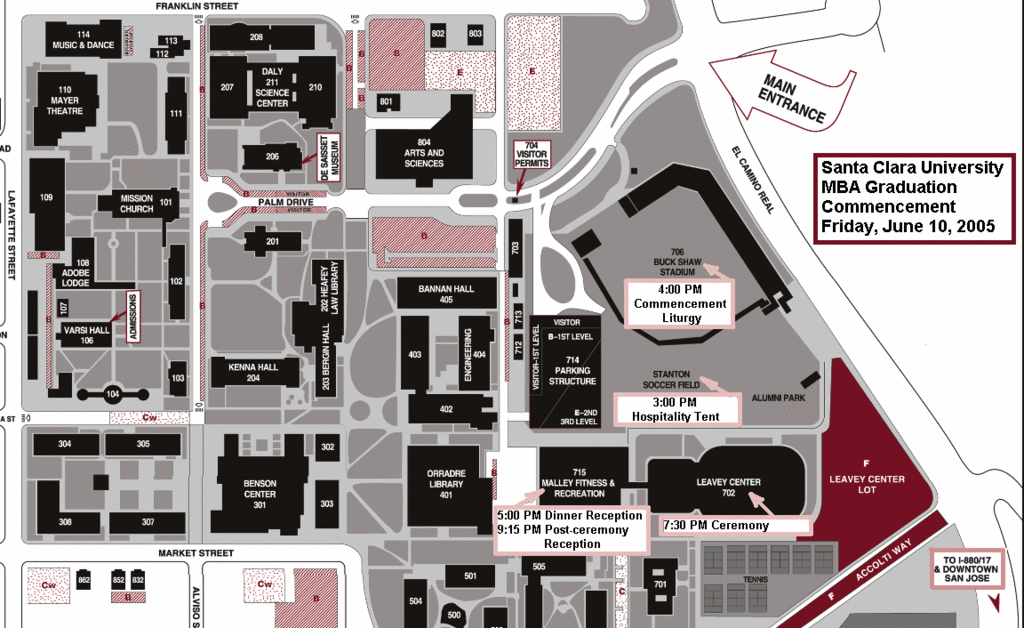
SCU MBA Graduation Commencement Map

If you're a Santa Clara University MBA student, here's a map you might find useful with some editing.


(Click image for a closer view.)

This is a map that I shared with those whom I invited to my graduation commencement on June 10, 2005.

All you need to do is to save this image to your hard drive, then edit it using any image editing program.

Microsoft Paint, which is included with every Windows computer, will do the job. You can usally find Microsoft Paint by navigating the Start menu: Programs/Accessories/Paint

Monday, July 25, 2005

SCU MBA Professor Feedback

Considering what classes to take, and want the inside scoop on class workload, professor's reaching style, and more?

For student feedback about professors, there are a number of resources available on four Yahoo! Groups. You'll need to join each group to see the professor reviews within the group's database and messages.

After registering for these groups, you'll find on the homepage of each group a link labeled "Database". Click on this link to view a list of tables, among which is a professor feedback table.

In these Yahoo! Groups, most likely many emails have already been written about a professor in question. To search all of the previous messages sent within a Yahoo! Group, click on the "Messages" link on the home page of a particular group. On the "Messages" page find the field labeled "Search", then fill in the last name of a professor and click "Go" to receive a list of all messages posted about that professor. You may want to refine your query by entering both the professor name and the class number (e.g. "Fox 551" for Dr. Karen Fox's MKTG 551 class).

The SCU MBA office also posts composite student feedback from end of quarter surveys. This information is only available from the campus network's intranet. This means that you can't look up the information over the Internet; you'll have to check the reviews at school by plugging your computer into a network jack or logging into one of the computer labs on campus.

For the capstone course, IDIS 619, please see SCU MBA Capstone Course (IDIS 619) Advice where you'll find my take on the class, as well as instructions for finding useful information at http://www.scucapstone.com

Rate My Professors is another resource for professor reviews.

Sunday, July 24, 2005

SCU MBA Capstone Course (IDIS 619) Advice

If you will be taking the capstone course IDIS 619 in the near future, you may find of interest the following conversation I had with an SCU MBA student on the SantaClaraMBA Yahoo! Group, in which I respond to questions about my experiences in taking the class:

> 1. How was the course workload (Madsen Vs. Palmer Vs. Leidecker)?

I just took the class with Professor Madsen. The workload is manageable as long as you keep up with the assignments. Hopefully you won't have any personal or work crises to disrupt your coursework; otherwise it's difficult to catch up.

> 2. Assuming that you are working full time, is it advisable to take
> Capstone by itself or is it manageable to take another course along
> with it?

I recommend taking Capstone by itself, since it is a lot of work. The workload was heavy and intense, but doable. I only took Capstone, but some of my classmates took multiple classes, and not only survived, but did very well. Not to say that it wasn't stressful on them.

> 3. Learning from what all core courses was used for the
> Capstone paper?

I believe MGMT 503 and MKTG 553 are definitely used. What else? I think what's most important is to know what is expected but NOT reviewed very deeply: financial analysis. Make sure you have at least one financial guru in your group who has taken some financial electives and/or uses financial analysis at work. Two gurus are better, so that if one makes a mistake, the other might catch it. Without financial gurus, you may find yourself spending a lot of time digging through your old textbooks and notes (if you still have them) trying to remember how to do all of those calculations. I suppose MGMT 503 knowledge could be leveraged for talking about the management within an organization and organizational structure. While I learned about Porter's Five Forces model in MKTG 553 and other classes, Professor Madsen goes much deeper into the advanced usage of the tool than any other class I took. Don't worry about reviewing it; she'll spend plenty of time teaching you the way that she wants you to use it. Be sure to ask questions. For example, it can get a little confusing remembering if a score of 1 is a good or bad thing for a company (you'll see what I mean when you go through it).

> 4. What all electives do you recommend should be taken
> prior to taking capstone?

As mentioned above, hopefully at least one or two people in your group have some financial electives under their belt so that they haven't forgotten as much as others may have about financial analysis. Otherwise, I think it's best to have a diverse group. So take any electives, and try to get in a group in which everyone hasn't taken the same electives as you. I can tell you that some of my Information Systems electives did not come into use at all in this class. But I don't regret taking them, as they were useful classes. I wouldn't recommend picking electives to prepare for Capstone. Just pick a smart, diverse group with a strong work ethic and you'll do very well! (Maybe easier said than done?)

> 5. How was your team forming process & experience?

Short, but useful. We all met as a group for the first time at the end of the quarter party right before the class started, and had one dinner meeting after that. Those two meetings were sufficient for us. I had Professor Heineke for Econ 401 the quarter previous to Capstone, which required my complete focus, so I wasn't even thinking about Capstone once I was on a team. Heineke was keeping me plenty busy before Capstone, and I have no regrets that we didn't meet earlier. Capstone is tough, but it's all doable within a quarter.

>6. Did you use scucapstone.com or yahoogroups for the project?

Our team used scucapstone.com and found it to be useful. It has a few quirks and a little bit of a learning curve, but overall was very useful. It was nice not having to worry about file attachment size limits or total storagelimits.

> 7. Would it be possible to share your Capstone papers
> with the group? If yes, please upload your papers @
> http://tinyurl.com/cxdcn

I'll have to check with my group. Also, I don't know if I advise looking at Capstone papers far in advance. Just know that it will be a lot of work, and that the professor (at least Madsen) will give you a sample of what is considered a good paper. As I've mentioned above, the class is all doable within a quarter. I think people could be overstressing themselves getting too prepared for the class. I'm glad I had Heineke the quarter before to keep me focused on the class in front of me. Otherwise, I might have been preparing for Capstone a quarter in advance (due to the verbal and email scare stories I've heard and read before), and would have gained little if any benefit. If everyone starts preparing a quarter in advance, then those wanting an edge for the Belotti award might start preparing two quarters in advance. Next thing you know, people will be researching Capstone companies before they submit their application for the MBA program! (OK, I exaggerate. Maybe) I humbly suggest for the health of everyone involved that the madness be nipped in the bud. Starting work on the Capstone class in the break before the Capstone quarter is reasonable (required for Madsen since an assignment is due the first day of class), but don't go overboard by not giving your previous quarter's classes your full attention because you're worrying about and working on preparing for Capstone (One exception: It is a good idea to find a team far in advance, maybe a quarter or two at least).

> Any other tips or advice would be very useful.

Check out scucapstone.com for a lot more Capstone advice. In the public forums, there is a thread called "General Discussion". Click on it to open it. The "sticky" thread at the top of the list is called "Capstone Recommendations". Click on it to read some more advice. Remember that everything posted as advice is advice and not the gospel truth that applies to and is best for everyone; your mileage may vary. Check out the other public forums on scucapstone.com for other useful information. And check out professor reviews within the database sections of a number of SCU MBA Yahoo!Groups (such as the Life Long Network, Women In Business, and the FinanceConnection), as well as on SCU's internal web site. For a list of SCU MBA Yahoo! Groups, see http://www.rickupton.com/scu-mba-msis-networks.htm Good luck!